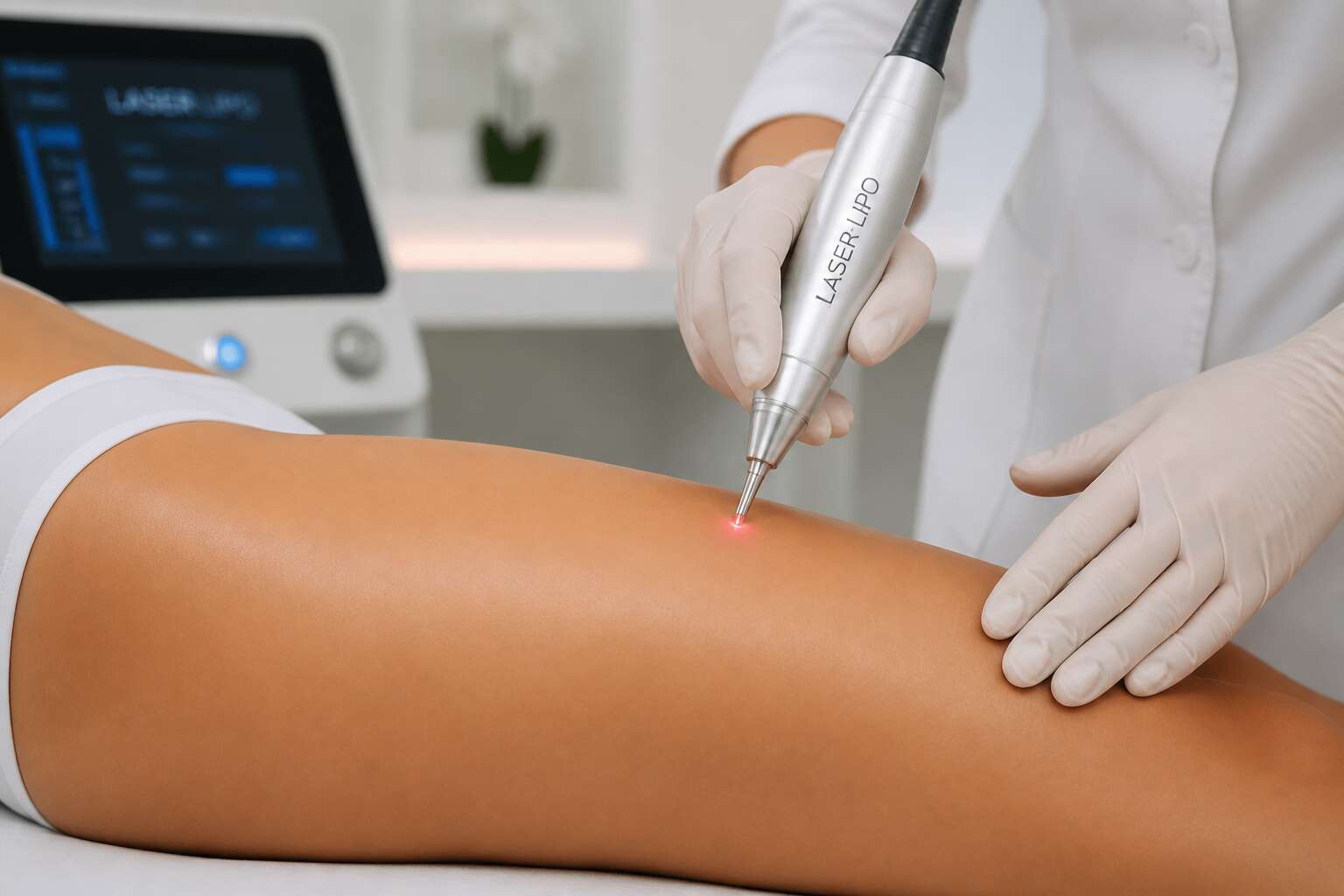
Understanding Cellulite and Its Causes
What Is Cellulite?
Cellulite is a structural distortion, a silent buckling beneath the skin. Fibrous septae tether the dermis while fat lobules push upward, producing a dimpled surface. This pattern affects up to 90 percent of post-pubescent women, most visibly on the thighs and buttocks.
Oestrogen weakens collagen integrity, while genetics set the arrangement of those septae. Reduced lymphatic outflow and prolonged sitting amplify the unevenness. We often fail to notice these changes until the surface distorts. The primary drivers are:
- Hormonal fluctuations
- Genetic connective tissue weakness
- Impaired circulation
Each alters the skin’s internal matrix. Understanding this structure matters when evaluating laser lipo for cellulite, a technique that releases fibrous bands and stimulates dermal remodelling.
Why Cellulite Forms
Cellulite is a social nuisance and a biological puzzle, but it is not a mystery. The dimpling that appears on the thighs and buttocks is a mechanical event, driven by the interaction between fat lobules and the fibrous septae that anchor the skin. When those septae pull down while the fat pushes up, the surface loses its smooth contour. This is why the condition is so difficult to address with weight loss alone. A smaller fat volume does not always resolve the tension created by the structural framework.
The origins of this imbalance are deeply rooted in the body’s architecture. Hormones influence the quality of collagen, which determines how much give the skin has. Genetics dictate the density and orientation of the connective tissue, setting the stage for how easily the dimples form. Lifestyle factors such as prolonged sitting or reduced circulatory efficiency can compound the issue by slowing the removal of cellular waste and fluid. The skin then becomes less responsive to change.
Laser lipo for cellulite addresses these underlying mechanics rather than the surface texture alone. The technology releases the tension of the fibrous bands and encourages dermal remodelling, which creates a smoother appearance. For those considering this treatment, the key is understanding that cellulite is not a simple excess of fat but a distortion of the layers beneath the skin. The effectiveness of the procedure depends on the severity of the connective tissue involvement and the body’s own healing response.
Common Myths About Cellulite
In South Africa, hot summers and beach culture keep legs on display, yet cellulite remains one of the most misunderstood skin conditions. Most people assume it is a weight problem, which fuels the stubborn myth that losing kilograms erases the dimples. Cellulite formation, however, is driven by structural factors that weight loss alone cannot touch.
Another misconception claims topical creams can flatten the surface. They simply cannot penetrate deeply enough to influence the connective tissue beneath. This is why laser lipo for cellulite has gained attention as a physical intervention that works from the inside out.
Common misconceptions:
- Only women develop cellulite
- Being fit prevents it
- Darker skin tones are immune
Each of these falls apart upon examination. Hormones, genetics, and circulatory efficiency determine how the skin responds. Those three pillars explain why the condition varies so widely between individuals.
Factors That Worsen Cellulite
According to dermatology journals, roughly 90% of post-pubescent women exhibit some degree of cellulite, a statistic that renders the condition less of a cosmetic anomaly and more of a biological default setting. The dimpling occurs when fibrous bands tether the skin to underlying tissue while fat cells push upward. This creates a mattress-like effect that no amount of dry brushing or coffee scrubbing will smooth.
The primary drivers are hormonal shifts, specifically estrogen fluctuations that influence blood flow and collagen production. Genetics dictate the architecture of those connective bands, while circulatory efficiency determines fluid retention in the affected areas. For those seeking intervention, understanding these mechanics explains why topical solutions fail and why laser lipo for cellulite targets the structural roots rather than the surface symptoms.
Several aggravators accelerate the appearance of these depressions:
– Dehydration plumps fat cells while shrinking the surrounding matrix, amplifying contrast
– Chronic stress elevates cortisol, which degrades collagen integrity over time
– Sodium-heavy diets promote water retention that stretches the skin thinner
Sedentary routines reduce lymphatic drainage, allowing toxins to linger in the interstitial spaces. Smoking constricts microcapillaries, starving the dermis of oxygen needed for repair. Each factor compounds the next, creating a cascade that makes the skin appear increasingly uneven. This complexity explains why a one-dimensional approach rarely yields visible results. Laser lipo for cellulite addresses the physical tethers and thickened septae directly, offering a mechanical solution where biological processes have failed to keep pace.
How Cellulite Differs From Regular Fat
Cellulite is not stubborn fat. It is fat trapped within a web of fibrous bands, and that is why dimples persist after weight loss. Regular fat expands and shrinks as one continuous layer. Cellulite comes from tension, not volume. The bands pull down, the fat pushes up, and the skin shows the outcome.
Laser lipo for cellulite works on that structural tension. It does not attempt to dissolve fat that already behaves normally. Instead, it targets the connective tissue that creates the mattress effect. Recognising this difference is the first step toward choosing a treatment that matches the problem.
How Laser Lipolysis Targets Cellulite
The Science Behind Laser Energy
Nine out of ten women have cellulite, and creams rarely change that. Laser lipo for cellulite takes a different path by acting beneath the skin. The science revolves around thermal energy.
Laser energy heats the dermis to a precise temperature. This heat breaks down the fibrous bands that cause puckering. It also causes fat cells to release their contents, which the lymphatic system then clears. Both effects happen in one session.
What makes this method distinctive is its selectivity. The laser targets subcutaneous tissue without disturbing the epidermis. It is not collagen stimulation or skin tightening alone. It is a physical alteration of the connective tissue.
Understanding this mechanism helps explain why results appear gradually. In my experience, the body needs time to process the released fat. That is how the method works at the cellular level!
Types of Laser Devices Used
A single wavelength rarely solves cellulite; the depth and absorption profile decide the outcome. Laser lipo for cellulite becomes surgical when the clinician selects the right device for the patient’s unique septal pattern.
How laser lipolysis targets cellulite follows a simple principle: different tissues absorb different wavelengths. A 1064 nm Nd:YAG penetrates deeper to firm the dermis, while a 1470 nm diode targets water within the septae. Together they release the tension that creates the dimpled surface.
Device categories commonly found in South African practice:
- Diode lasers at 924 and 975 nm for fat emulsification
- Nd:YAG lasers at 1064 nm for deeper thermal effects
- Combination units that alternate wavelengths in one pass
My experience shows the choice of device changes the recovery curve. Higher wavelengths cause less bruising, while shorter pulses are more aggressive. Knowing these distinctions matters more than brand names.
The Procedure Step by Step
A single session can last forty minutes, yet the sequence of steps decides the result. I have watched patients assume the laser does all the work; in reality, the clinician’s rhythm dictates the outcome. The procedure for laser lipo for cellulite follows a deliberate path that balances thermal effect with tissue preservation.
- The skin is marked to map the septal bands.
- A local anaesthetic is infiltrated to numb the target zone.
- The laser fibre enters through a tiny incision, often no larger than a needle hole.
- Pulses of energy are delivered in a sweeping motion to release tension on the fibrous strands.
- The treated area is massaged to redistribute remaining fat and smooth the surface.
This approach reduces the risk of thermal injury while preserving the collagen matrix. The entire process feels more like controlled sculpting than destruction! Every pass of the fibre requires patience, because rushing the thermal spread creates uneven results.
What Happens to Fat Cells
Heat changes everything! When laser energy meets adipose tissue, the fat cell membrane loses integrity. The cell releases its stored triglycerides, which the body then metabolizes. This is why laser lipo for cellulite works differently from simple suction. It does not yank fat out. It triggers a metabolic process that clears the fat without mechanical force.
What survives this process matters as much as what disappears. The laser’s thermal effect also tightens the fibrous septae, the same bands that create dimpling. A controlled contraction occurs. The skin’s support network becomes more taut.
- fat cells shrink and collapse
- released lipids enter the lymphatic system
- surrounding collagen remodels
The result is a softer contour rather than an empty pocket. That distinction is why laser lipo for cellulite feels like restoration, not removal.
How Skin Tightening Occurs
Cellulite is a structural condition, not a flaw. Laser lipo for cellulite addresses that structure directly. The optical fiber reaches the deep dermis, where it disrupts fibrotic septae pulling the skin downward. Those bands release tension, and the dimpled surface softens.
Skin tightening unfolds through collagen dynamics. Heat makes existing collagen fibres contract immediately. Over subsequent months, neocollagenesis builds new supportive tissue, reinforcing the dermis.
The progression is consistent:
- Fibrous bands release under thermal energy.
- Collagen contracts and shortens.
- New collagen forms gradually.
I have seen early improvements within weeks, with the full effect arriving later. This restoration, not removal, defines the outcome.
Expected Results and Recovery
Timeline for Visible Improvements
Every body has a recovery schedule, and the first marker usually appears before the month ends. Within ten to fourteen days, the lymphatic system clears the debris of disrupted fat cells, revealing a preliminary shift in skin smoothness. The deeper remodeling, however, asks for more time.
- Weeks one to two: mild swelling masks results, so patience is advisable.
- Weeks three to four: visible smoothing begins as collagen remodels.
- Months two to three: full contour emerges with sustained firmness.
Recovery remains modest, requiring no more than a day of rest. Some tenderness or bruising appears, then fades within a week. The body’s regenerative phase continues for up to three months, which is why laser lipo for cellulite offers such a gradual natural evolution.
What Results Can You Expect?
Expect visible change, but not overnight. Laser lipo for cellulite triggers a biological response that unfolds gradually. The first signs of smoother skin appear before you expect them, while deeper structural improvements develop quietly.
Recovery stays simple! You might feel some tenderness or see light bruising for a few days. Many of my patients in Cape Town return to work the next morning. Swelling can momentarily obscure results, so patience is part of the process. Typical experiences include:
- Mild soreness in the treated area
- Light bruising that fades within a week
- A tingling sensation as nerves reawaken
Your skin gradually feels firmer as the tissue settles. For most, this leads to a softer, more even contour that looks natural.
Managing Discomfort and Downtime
Seventy two hours is when swelling peaks after laser lipo for cellulite. Then it recedes. The treated area feels warm for the first day, a sign the biological response is active, not a complication. Managing discomfort is straightforward with simple measures. Our patients often ask what recovery feels like, and the answer is less than they expect.
Recovery includes a dull ache that fades daily. Inflammation settles faster when you stay gently active. Do not judge the outcome by the first week. The tissue needs weeks to remodel.
- The area is kept cool with a clean cloth, not ice directly
- Light mobility aids lymphatic drainage
- Alcohol is avoided for the first 48 hours
A laser lipo for cellulite session does not sideline you. A Friday session gives you the weekend to settle before resuming your routine. Pushing through pain is counterproductive. The discomfort is manageable, the downtime is brief.
Combining With Other Treatments
The expected outcome of laser lipo for cellulite is rarely a standalone affair. Recovery is the beginning of that narrative, but the final texture depends on how well the procedure integrates with your existing habits. A patient who pairs the session with resistance training and adequate hydration sees a more settled dermis than one who leaves the tissue to its own devices.
Combining treatments requires timing. Topical retinoids can appear after the first week to support collagen synthesis, but only once initial heat has subsided. Sensible pairing during recovery includes:
- Gentle manual lymphatic drainage from a therapist, starting day three
- Low impact swimming after inflammation recedes, given South African pools are often cool
Other injectables or microneedling should wait a month after laser lipo for cellulite. The skin remodels on its own schedule, and pushing modalities into that window complicates the equation. Patience remains the decisive variable.
Long-Term Maintenance Tips
Once the initial recovery period ends, the real test begins. Laser lipo for cellulite can reduce the appearance of dimpled skin, but it does not grant permanent immunity from your own choices. The tissue responds to how you treat it for months afterwards.
Long-term maintenance is a series of unglamorous decisions. Weight stability matters, as does sun protection and consistent hydration. Some clients treat the procedure as a one-time fix, and blame the technology when dimples return.
- Maintain a stable weight; repeated gains and losses stretch fibres and undo progress.
- Apply SPF daily; UV exposure breaks down collagen and toughens the dermis.
- Schedule a six month review; one touch-up session often beats years of neglect.
The skin behaves differently at month six than at week six. The deeper collagen response continues, so let the tissue settle before judging the outcome. Laser lipo for cellulite starts the process; you finish it.
Cost, Risks, and Candidate Suitability
Average Cost of Treatment
The average cost of laser lipo for cellulite in South Africa typically lands between R4,000 and R12,000 per session. That price fluctuates with the clinic’s location, the device used, and the number of treatment areas. The procedure rarely requires anaesthesia, which keeps extras low.
As for risks, most patients only encounter short-lived redness or tenderness. More serious complications, such as skin burns or contour irregularities, occur mainly when technicians lack experience. Always verify credentials before booking. Consider these potential side effects:
- Mild bruising that fades within a week
- Temporary numbness in the treated zone
- Rare cases of hyperpigmentation
Candidate suitability hinges on your skin’s elasticity and the nature of your cellulite. Laser lipo for cellulite works best for people with moderate dimpling and loose skin, not for those with significant excess fat. Ideal candidates also maintain a stable weight, since shifting kilos can distort results.
Potential Side Effects
Cost is a negotiation most patients lose before they speak. The price of laser lipo for cellulite is rarely a single number; it is a menu of add-ons, from compression garments to follow-up visits. I always ask what happens if the first session underdelivers. A clinic that charges extra for corrections is a clinic that expects to make them.
Risks are as much about judgment as biology. Bruising and numbness are temporary, but burns and uneven contours appear when the operator mistakes a device for a skill. Do not trust a technician who promises smoothness without mentioning the word ‘candidate’. If they cannot explain why your skin type matters, they are not the one.
Suitability, then, is the central factor. Laser lipo for cellulite flatters moderate dimpling and skin with some resilience. It will not compress a lifetime of weight gain, nor will it tolerate a yo-yo scale. The ideal patient arrives at a stable weight with impossible dreams and reasonable expectations.
Potential side effects are best treated as a checklist:
- Bruising that fades, provided you do not poke it
- Numbness that politely departs within a week
- Pigmentation that lingers if you neglect sunscreen
Who Is an Ideal Candidate?
Cost is a conversation about expectations, not just currency. When I weigh the price of laser lipo for cellulite, I consider the technology’s generation, the operator’s track record, and the follow-up care. South African clinics vary enormously; the wise patient pays for the initial assessment before anything touches their skin.
Risks narrow to one question: who holds the handpiece. A skilled operator reads the tissue’s response in real time. An unskilled one merely follows a timer. That single difference changes the final result.
The ideal candidate for this stubborn dimpling fits a precise profile:
- Maintains a steady body weight for several consecutive months
- Shows dimpling that responds when the skin is lifted
- Views the treatment as texture correction, not volume reduction
Laser lipo for cellulite suits those who bring patience, not pressure, to the procedure.
Questions to Ask Your Provider
Quoted prices rarely tell the whole story. In South Africa, the initial fee for laser lipo for cellulite often excludes compression garments and follow up appointments. Ask your provider for a full breakdown before you book! Most clinics will give one if they expect you to return.
Risk management comes down to the operator’s experience. A practitioner who explains the device’s settings and shows you a tissue response plan is different from one who only mentions sales. I always recommend checking for certification and asking about complications.
- How many laser lipo for cellulite cases have you treated in the last year?
- What specific side effects have you seen in your own patients?
- What is your aftercare protocol for unexpected swelling?
The answers should be direct. Hesitation or generalities are warning signs. Pick a provider who offers clear protocols and honest outcomes.
Comparing Laser Lipo With Other Cellulite Treatments
Laser vs. Cryolipolysis
Cryolipolysis freezes fat cells into submission, but laser lipo for cellulite works on the tissue architecture itself. In the South African climate, where swimwear season barely pauses, that distinction shapes your results. Freezing handles compressible fat; it leaves the fibrous bands untouched.
Laser energy heats the dermis, dissolving fat while prompting collagen contraction. You see the difference in skin texture afterward, smoother, more pliant, with improved elasticity that freezing cannot replicate.
- Cryolipolysis only reduces fat volume
- Laser lipo for cellulite also releases septae and tightens skin
- Freezing acts on one plane, heat works across multiple tissue layers
Recovery differs as well. Cryolipolysis often leaves numbness for weeks. Laser lipo brings mild tenderness for a few days, which suits a Johannesburg work week far better.
Laser vs. Acoustic Wave Therapy
Acoustic wave therapy sends mechanical pulses through the skin to break up fibrous bands, yet it does nothing for the fat volume sitting beneath. The result is a modest smoothing effect, often requiring multiple sessions to notice anything. Laser lipo for cellulite works deeper, heating the dermis while dissolving fat cells in the same treatment.
That difference matters for the way your body looks under a bikini. Acoustic waves remodel tissue, but they cannot shrink the bulge. Here is a quick comparison:
- Acoustic wave therapy targets septae only
- Laser lipo targets fat, collagen, and septae together
- Laser lipo for cellulite produces texture changes faster
For most patients in Johannesburg, the choice is straightforward. If you want smoother skin and reduced volume, laser lipo offers a more complete answer than acoustic waves alone.
Laser vs. Topical Creams
Topical creams promise a lot. Most of them deliver caffeine, retinol, or peptides to the skin’s surface. The structural changes that lead to cellulite sit deeper, in the dermis and the subcutaneous fat layer. Those ingredients rarely reach that depth. You may see a temporary firming effect, but it fades within hours.
Laser lipo for cellulite bypasses the surface. The practitioner inserts a fiber under the skin and heats the tissue directly. This reduces fat cells and tightens collagen at the same time. Compare that with what a cream can do:
- Topical creams affect only the outermost layers of the skin
- Laser lipo targets the fat layer directly
- Laser lipo changes collagen structure; creams do not
Creams may improve surface texture. They will not shrink the fat pocket pushing against the skin. Laser lipo for cellulite produces longer lasting effects because it changes the tissue underneath.
Laser vs. Radiofrequency
Radiofrequency and laser lipo both rely on heat, yet they approach the problem from opposite directions. A radiofrequency handpiece glides over the skin, warming the dermis to provoke collagen contraction. It feels pleasant, almost like a hot stone massage. Laser lipo for cellulite, however, requires a thin fiber to breach the skin and deposit energy precisely inside the fat layer. That difference is not academic. It changes what each method can actually accomplish.
Radiofrequency excels at tightening lax skin, which helps smooth the appearance of dimples. But it does little to reduce the fat pockets that cause the dimpling in the first place. Laser lipo for cellulite attacks the fat directly while simultaneously heating collagen. If your primary concern is the lumpy pocket itself, the laser reaches the structural culprit. Radiofrequency stays closer to the surface, a distinction that becomes obvious once you review the results side by side.
How to Choose the Right Option
The biggest lie in cellulite treatments is that surface-level energy can fix a structural problem. Most devices on the market only massage, vibrate, or warm the skin, leaving the fibrous septae intact. Those connective tissue strands create the dimpled traction you see on your thighs. That’s where laser lipo for cellulite differs. A thin fiber slips beneath the skin and severs those tension bands while melting the prolapsing fat. No amount of gliding, suction, or cooling will release a fibrous band. The laser breaks it directly. That separation alone changes the calculus compared to anything you’ll experience on a treatment bed.
Consider vacuum-based suction therapy, which feels vigorous for twenty minutes. The skin plumps from increased circulation and looks smoother for a few days. Then the fluid reabsorbs and the dimpling returns. Why? Because suction pulls tissue upward but does nothing about the anchor points pulling down. Laser lipo for cellulite alters that tension system entirely. By disrupting the septae and shrinking the fat herniation, the skin re-drapes without the tether. It is a structural change, not a temporary squeeze. If your skin has firm elasticity and a defined fat pocket underneath, the laser resolves both layers in one pass. In my experience, laser lipo for cellulite offers the most direct path when the fat pocket exceeds a centimeter in depth.
Choosing the right option comes down to your anatomy. Ask yourself three questions:
- Is the cellulite visible when you’re lying down, which points to a fat-dominant problem?
- Do you have thin, crepey skin that might sag if you remove fat without tightening it?
- Are you prepared for mild bruising and a week of compression garments, not just temporary redness?
If you see trapped fat and healthy skin tone, laser lipo for cellulite outperforms every non-invasive device. If laxity alone drives your concern, neither suction nor massage will deliver it. The laser’s heat contracts collagen while its fiber releases bands, delivering both results without swapping fat for a wrinkle.
I’ve watched too many patients spend money on machines that glide across the surface and deliver little beyond temporary warmth. The logic is simple. For dimples caused by taut bands and fat lobes, laser lipo for cellulite remains the only method that directly tackles both. Suction massage compresses the tissue temporarily but never cuts a band. Injections dissolve small pockets unevenly. Manual massage stimulates circulation but changes nothing structurally. When you compare the cost of repeated sessions that most other treatments demand, the laser often wins on value too. The device that feels nice in the moment rarely changes the tissue structure months later.



0 Comments